A e.Book [Fake Coins of Republic India] of all the items is available as PDF in download section.
This article is on Fake Indian Coins and Currencies is Organised into 5 parts.
Part 1 - Fake Commemorative Coins
Part 2 - Fake Definitive Coins
Part 3 - Fake Currencies
Part 4 - Fake Error Coins.
Private Package UNC Set
Use the Index or older / newer post to navigate
The fake market is not just restricted to circulating coins & currencies, but also in the Error coins markets. The demand for error coins at times outstrips the supply. Further error coins are never cataloged and hence you can be creative in doing fakes errors and sell them for quite a sum. Unlike minting of fake coins that require access to a minting press plus investment into design etc, a fake error coins can be created just from ordinary circulating coin, use of lathe machine and of course a bit of creativity.
Although it’s difficult to document all fakes error coins, one may not even see, this section tries to list out some of the ways these fake error coins are made so that it becomes easier to identify.
Reader caution is advised in this section as I could have erred in calling some of the genuine error coins as fakes. The classification of these coins as Fake is based on the IMAGES I have come across and my knowledge on minting process that leads to error coins. At times there could be some unexplained error during minting that could have produced these coins, however this section should serve more as a caution to a collector and not get carried away in buying error coins assuming that these are genuine.
This article is on Fake Indian Coins and Currencies is Organised into 5 parts.
Part 1 - Fake Commemorative Coins
Part 2 - Fake Definitive Coins
Part 3 - Fake Currencies
Part 4 - Fake Error Coins.
Private Package UNC Set
Use the Index or older / newer post to navigate
The fake market is not just restricted to circulating coins & currencies, but also in the Error coins markets. The demand for error coins at times outstrips the supply. Further error coins are never cataloged and hence you can be creative in doing fakes errors and sell them for quite a sum. Unlike minting of fake coins that require access to a minting press plus investment into design etc, a fake error coins can be created just from ordinary circulating coin, use of lathe machine and of course a bit of creativity.
Although it’s difficult to document all fakes error coins, one may not even see, this section tries to list out some of the ways these fake error coins are made so that it becomes easier to identify.
Reader caution is advised in this section as I could have erred in calling some of the genuine error coins as fakes. The classification of these coins as Fake is based on the IMAGES I have come across and my knowledge on minting process that leads to error coins. At times there could be some unexplained error during minting that could have produced these coins, however this section should serve more as a caution to a collector and not get carried away in buying error coins assuming that these are genuine.
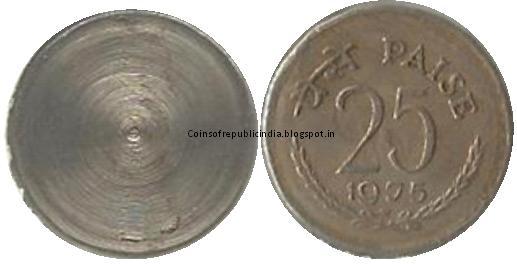
One Side Printed:
I came across this fake which said one side printing. Although I have not physically seen the coin, its easy to identify this. To me it looks like a regular coin that was taken and one side was doctored using a lathe machine. Notice the circular shape of the metal. A good planchet will not show such kind of circular marks. Plus the obverse looks like the fake Rs 1, 1985 Dabbu coin. Its possible that quite a few of these were minted and are not getting sold. Definitely try to be more creative to sell the stock J.
Rs 2 Cupro-Nickel
I came across a Rs 2 Cupro-Nickel stuck on a 50 paise flang. Notice the date of 1999, the 50 paise in cupro-nickel was last minted in 1990. A planchet cannot find its way after 10 years. It is very unlikely that a cupro-nickel sheet was blanked using a 50 paise size. Also the edges are raised. This is very unlikely as the die would definitely flatten out the rim.
10 Paise on 5 Paise


Oval Shape:
I came across this error coin which shows the shape of the coin as Oval. There is no stage in minting process that can lead to this type of error. In the planchet making stage, there is no process error that would make the blank Oval instead of circular. If a coin is stuck on a smaller flang, it can expand, typically still being more or less circular, lets say by outside chance, it took on an oval shape, however then there are 2 issues with this theory, there was no blank in cupro-nickel smaller than the 25 paise blank. Secondly, the max diameter of the coin on the oval edges is still the size of 25 paise. Hence it looks like a perfectly round 25 paise coin is taken and then given a oval shape in the workshop.

This error typically happens during the die making process as the mint marks and dates are added later to the working die. At times they miss out putting the date. However forgers use this knowledge and using a lathe machine remove of the date portion. The image below, I had purchased a coin assuming it to be missing partial date. On close inspection with the 15x magnification lens, I could notice that the date was actually removed. The surface near the date was imperfect, indicating tampering. There is a remote chance that this still can be genuine, but I cannot figure out a process that would have lead to this kind of error.

Chipped Planchet:
It is quite easy to create this type of fake. Take a normal coin and cut out a straight edge or curved edge to create a chipped planchet. In a genuine error coin, there is always expansion near the chipped area, there is a strike weakness around the chipped area, and the edge is more rounded inside. In a fake error coin of this type, the strike does not show weakness, the edge is straighter. The easiest in these are the Aluminum coins that are easy to cut and work with.
In the below image shows a 10 paise that is possibly a fake.

Missing Inner Ring in Bi-Metallic:
In the Rs 10 Bi-metallic coins, there is a type of error where by the inner portion of the coin is missing. However this type of error is easy to create outside the mint. Heat the coin to a high temperaturre and press the center sharply to get it seperated.
I came across the below coin being sold by a reputed dealer on eBay. I think its fake;
- The inner rim does not flatten which would have been the case if the coin was stuck without the inner portion. The rim its more weavy and bends both inwards and outwards.
- The strike at the inner edges is not weak, it should be as when the coin gets stuck, the metal near inner edge would expand an the impression would be weak.

Only Center Piece:
The other portion of the Center piece is sold as separate error coin. See images below.
- If only center piece finds its way to striking chamber, its highly unlikely that it will stay exactly in center for the strike.
- Lets for a minute assume that by some miracle the coin indeed rests exactly in the center; the strike should have expanded the coin as there is no ring to contain the metal flow. Further there should be weakness of the strike at the edges.
- Well one might say that the coin was struck with both the inner and outer ring, and after strike they got separate. Well the strike at that pressure generates intense heat and it would fuse the pieces and they would be inseparable.

Uneven Metal Surface:
There is no known process [at least to me] that can produce this kind of error coin. It looks very obvious to me that a normal coin was taken, and using a round punch pressure was exerted resulting in this uneven shape. Something done outside the mint and not in mint.

Indira Gandhi 50 Paise Coin:
I don’t know what the forger had in mind when he created this master piece. Maybe wanted to pass this off as Off-strike [must have heard somewhere that only partial image should be visible] or maybe wanted to create struck on wrong flang; only the forger can tell for sure

2002 Rs 10 Veer Durga Das
The Rs 10 Veer Durga Das coin that was available only in UNC Set’s was creating a round where it looked like due to some kind of double strike error there was both the images on the coin. This was debated as to how this error could have happened, and it was concluded that such kind of error happening in the mint was not a possibility.
For this to have occurred in mint, there should have been brockage on both the dies [highly unlikely], plus the brockage on one side should have had a 180 deg rotation. And then another coin struck normally and then struck with brockage on both the dies … huge impossibility and even one would not be able to sequence the events.
The coins are real in terms of all parameters like weight, composition, design etc.
Outside the mint its easy to get this one, heat 3 coins to a temperature … stack them together and then apply pressure.
This coin was listed by a major auction house was then removed with experts pointed out this is a fake.