Showing posts with label YR-2001 To 2010. Show all posts

2010 - C Subramaniam Birth Centenary - Hyderabad Mint

This Post gives the details of  Hyderabad Mint UNC Set. For other Proof & UNC Set refer to the Previous Posts

========= Continued from previous Post ========================

Proof Set: Coins of Rs 100 & Rs 5
Refer to the Previous Post

UNC Set from Mumbai Mint: Coins of Rs 100 & Rs 5
Refer to Previous Post


For Hyderabad Mint Coin Sets please refer to the next Post.
UNC Set: Single Coin of Rs 5


Notice that the coin image does not have the Mint mark. Possibly the Mint used the coin minted by Kolkata Mint as the image here. A brief discussions on these design can be found at Hyderabad Mint Single Coins Sets


UNC Set: 2 Coins
Coins of Rs 100 and Rs 5.
For the first time the Hyderabad Mint has issued a 2 Coin UNC set with Silver Coin. As to why the mint choose to strike sets that were already struck by other mints is not sure. This would be for the first time in the history of Indian Proof & UNC Set that a high denomination set was struck by 2 mints. As part of this, the Hyderabad mint had struck the RBI Platinum Jubilee, C Subramaniam, Civil Aviation and ICMR


2010 - C Subramaniam Birth Centenary - UNC Set - Mumbai Mint

This Post gives the details of UNC Set. For Proof Set refer to the Previous Post

The 5th Coin in the Year 2010 was to celebrate the Birth Centenary of C Subramaniam. A Proof set and UNC Set was released. Following are the details


Chidambaram Subramaniam (January 30, 1910 - November 7, 2000), was an Indian statesman (Freedom fighter, state minister, central minister and governor of state) He was the man who ushered in an era of self-sufficiency in food production in India. He was conferred the India's highest civilian award Bharat Ratna in 1998.
Subramaniam participated in the freedom struggle actively and went to prison. He was later elected to the Constituent Assembly and had a hand in the framing of the Constitution of India.
A protege of Rajaji, Subramaniam was trained in the rudiments of politics and administration. He was a Minister (Education, Law and Finance) in the then Madras State from 1952 to 1962. He was the Leader of the House in the Madras Legislative Assembly for 10 years from 1952. He was elected to the Lok Sabha in 1962 and was the Minister for Steel and Mines. Subsequently, he handled important portfolios like agriculture (in 1965 when he spearheaded the Green Revolution), and later the portfolios of Finance and Defence. He was the finance minister during the emergency. He also worked as the deputy chairperson of the planning commission of India.
When the historic split in the Congress took place in 1969, he cast his lot with Indira Gandhi and became the interim president of the faction she headed. He stood by her when she clamped the Emergency in 1975, but parted ways later and joined the Congress (Urs) faction led by Devraj Urs
C. Subramaniam was appointed Governor of Maharashtra in 1990. He transformed the Raj Bhavan into a beehive of activity by holding frequent meetings with leading academics, industrialists, representatives of non-governmental organisations and prominent citizens on issues crucial to the community. He had to resign after a newspaper reporter overheard and published an informal remark of his criticising the style of functioning of the then Indian Prime Minister, Mr P.V. Narasimha Rao
C. Subramaniam is best known as the architect of India’s modern agricultural development policy, after the success of his programme which led to a record production of wheat in 1972 — an achievement termed as the Indian Green Revolution. As Minister for Food and Agriculture, he played a decisive role in the introduction of high-yielding varieties of seeds and more intensive application of fertilizers which paved the way for increased output of cereals in the late 60s and attainment of self-sufficiency in food-grains in the country.
He was the founder of National Agro Foundation, Chennai and Bharathidasan Institute of Management Tiruchirappalli
He was awarded the nation's highest civilian honour, the Bharat Ratna in 1998.

Proof Set: Coins of Rs 100 & Rs 5
Refer to the Previous Post


UNC Set: Coins of Rs 100 & Rs 5


The Coins


Mule UNC Set: Coins of Rs 100 & Rs 5
The Mule coin of Rs 5 that has the Obverse similar to the RBI Rs 5 Coin.
This was found only in the UNC set. 


The strange story of this mule. The Obverse used here was the one from Rs 5 RBI coin. Amongst the coins in 2009 and 2010, only the RBI coin had a distinctive different design that was not used with any other commemoratives issued. Hence it is surprising to see the Obverse of Rs 5 that was used on the RBI. Further this is only in the UNC Set.
The UNC Sets were manufactured in 2 lots. Initially these were available from the Mint counter from January 2012 to April 2012. These coins had regular Obverse. The booking were invited in January 2012. Somewhere in May 2012 to July 2012, the UNC sets that were booked were being delivered, amongst them the first lot of deliveries had the coin with Obverse used for the RBI coin. Subsequent dispatches had the regular Obverse.
It is also difficult to treat this as Mule as it's in UNC Set. The UNC sets are supposed to be hand struck and each coin inspected [unlike mass produced coins for circulation]. Hence it can be argued that this was on purpose and hence can be treated as a Die Variety rather than a mule.


For Hyderabad Mint Coin Sets please refer to the next Post.
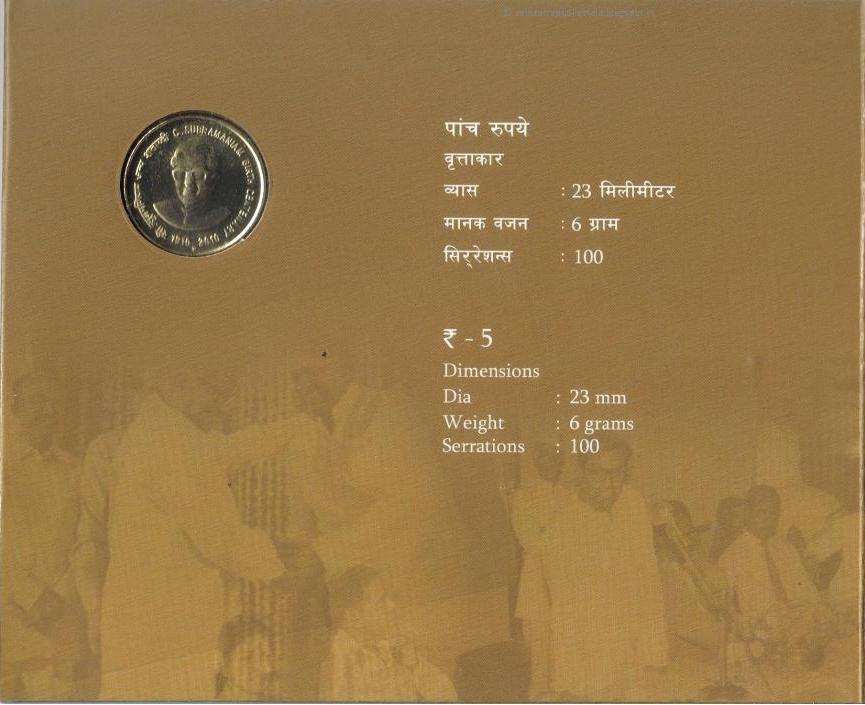
UNC Set: Single coin of Rs 5
UNC Set: 2 Coins of Rs 100 and Rs 5


2010 - C Subramaniam Birth Centenary - Proof Set

This Post gives the details of Proof Set. For UNC Set please refer to the previous post.

The 5th Coin in the Year 2010 was to celebrate the Birth Centenary of C Subramaniam. A Proof set and UNC Set was released. Following are the details


Chidambaram Subramaniam (January 30, 1910 - November 7, 2000), was an Indian statesman (Freedom fighter, state minister, central minister and governor of state) He was the man who ushered in an era of self-sufficiency in food production in India. He was conferred the India's highest civilian award Bharat Ratna in 1998.
Subramaniam participated in the freedom struggle actively and went to prison. He was later elected to the Constituent Assembly and had a hand in the framing of the Constitution of India.
A protege of Rajaji, Subramaniam was trained in the rudiments of politics and administration. He was a Minister (Education, Law and Finance) in the then Madras State from 1952 to 1962. He was the Leader of the House in the Madras Legislative Assembly for 10 years from 1952. He was elected to the Lok Sabha in 1962 and was the Minister for Steel and Mines. Subsequently, he handled important portfolios like agriculture (in 1965 when he spearheaded the Green Revolution), and later the portfolios of Finance and Defence. He was the finance minister during the emergency. He also worked as the deputy chairperson of the planning commission of India.
When the historic split in the Congress took place in 1969, he cast his lot with Indira Gandhi and became the interim president of the faction she headed. He stood by her when she clamped the Emergency in 1975, but parted ways later and joined the Congress (Urs) faction led by Devraj Urs
C. Subramaniam was appointed Governor of Maharashtra in 1990. He transformed the Raj Bhavan into a beehive of activity by holding frequent meetings with leading academics, industrialists, representatives of non-governmental organisations and prominent citizens on issues crucial to the community. He had to resign after a newspaper reporter overheard and published an informal remark of his criticising the style of functioning of the then Indian Prime Minister, Mr P.V. Narasimha Rao
C. Subramaniam is best known as the architect of India’s modern agricultural development policy, after the success of his programme which led to a record production of wheat in 1972 — an achievement termed as the Indian Green Revolution. As Minister for Food and Agriculture, he played a decisive role in the introduction of high-yielding varieties of seeds and more intensive application of fertilizers which paved the way for increased output of cereals in the late 60s and attainment of self-sufficiency in food-grains in the country.
He was the founder of National Agro Foundation, Chennai and Bharathidasan Institute of Management Tiruchirappalli
He was awarded the nation's highest civilian honour, the Bharat Ratna in 1998.

Proof Set: Coins of Rs 100 & Rs 5


UNC Set: Coins of Rs 100 & Rs 5

See Next Post


2010 - 1000 Years Of Bridadeeswarar Temple - UNC Set and Mint Card

The Link to All Articles is here
The Link to All Proof and UNC set is here


This Post gives the details of the UNC Set. For Proof Set, Please refer to previous post. For Hyderabad Mint UNC refer here.


In the year 2010, to commemorate the 1000 Years of Bridadeeswarar Temple a commemorative Proof set and UNC Set was issued. This is for the fist time that an Rs 1000 Coin will be issued. A Rs 5 circulation coin was also issued.
The Details are;


The Peruvudaiyar Koyil or Brihadeeswarar Temple, also known as Rajarajeswaram, at Thanjavur in Tamil Nadu, is the world's first complete granite temple and a brilliant example of the major heights achieved by Cholas kingdom Vishwakarmas in temple architecture. It is a tribute and a reflection of the power of its patron RajaRaja Chola I. It remains as one of the greatest glories of Indian architecture. The temple is part of the UNESCO World Heritage Site.
The temple stands amidst fortified walls that were probably added in the 16th century. The 'Vimana' - or the temple tower - is 216 ft (66 m) high and is among the tallest of its kind in the world. The Kalash or 'Chikharam' of the temple is not carved out of a single stone as widely believed. There is a big statue of Nandi, carved out of a single rock, at the entrance measuring about 16 feet long and 13 feet high. The entire temple structure is made out of hard granite stones, a material sparsely available currently in Thanjavur area. Built in 1010 AD by Raja Raja Chola in Thanjavur, Brihadishwara Temple also popularly known as the ‘Big Temple’ has turned 1000 years in September 2010
To celebrate the 1000th year of existence of the grand structure, the state government and the town held many cultural events. It was to recall the 275th day of his 25th regal year (1010 CE) when Raja Raja Chola (985-1014 CE) handed over a gold-plated kalasam for the final consecration to crown the vimana, the 59.82 metre tall tower above the sanctum
On September 26, 2010 (Big Temple’s fifth day of millennium Celebrations), as a recognition of Big Temple’s contribution to the country’s Cultural, Architectural, Epigraphical history, a Special 5 Postage Stamp featuring the 216-feet tall giant Raja Gopuram was released by India Post. The Reserve Bank of India commemorated the event by releasing a 5 coin with the model of temple embossed on it.


UNC Set:
Coins of Rs 1000 and Rs 5


The Coins:


Mint Card: 
Single Coin of Rs 5