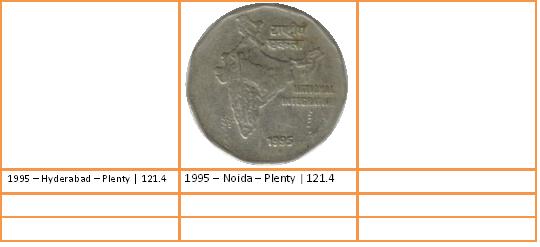
This post is organized in 2 parts. The first part details about the Cupro-Nickel issues. This post details about the other definitive issues.
 This is one of the most controversial designs. The design
was described as “Unity in Diversity”. The modern design was to be read as
“Four heads sharing a common body”. It was to represent people from different
parts / walks of life coming together and forming the Nation. The design was
first introduced on the One Rupee coin in 2004, and later was taken to Rs 2 and
Rs 10 as well. The last to be minted was on Rs 5 coin. Hindu groups saw this
design as “Cross” and associated it with Christianity. This forced the
Government to adopt new time tested floral designs.
This is one of the most controversial designs. The design
was described as “Unity in Diversity”. The modern design was to be read as
“Four heads sharing a common body”. It was to represent people from different
parts / walks of life coming together and forming the Nation. The design was
first introduced on the One Rupee coin in 2004, and later was taken to Rs 2 and
Rs 10 as well. The last to be minted was on Rs 5 coin. Hindu groups saw this
design as “Cross” and associated it with Christianity. This forced the
Government to adopt new time tested floral designs.


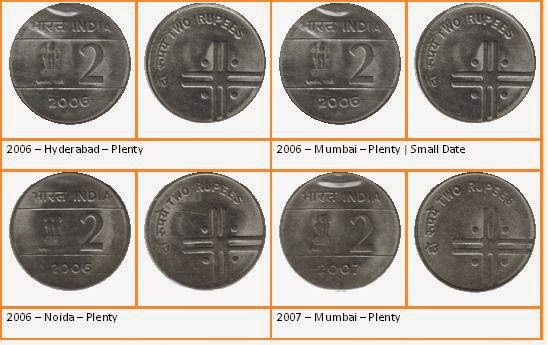
 Amongst the most ill-struck
coins. Finding a good specimen is more difficult that an error prone one.
Amongst the most ill-struck
coins. Finding a good specimen is more difficult that an error prone one.
- Most die exhibit a weak strike
- Partial or missing “Jayate” in most coins
- Mild die clash visible on both side of quite a few coins


Plain Edge Die Variety
Amongst the most controversial coins of the times, the Unity
in Diversity theme was adopted for the Definitive coins. The Rs 2 coin was most
widely available in circulation. The Rs 5 was struck with only one date of 2007
from Kolkata mint. Although the coins were struck only for a brief period of 3
years, there are quite a few die variations and other mysteries. The best being
the Orientation of the Obverse with respect to the Reverse.

This coinage has a strange story of Orientation, the coins
of 2005 come in both orientation “+” and “X”. This is not just in one
denomination, but across Rs 10 and Rs 1 as well.
Apart from this, it is apparent that 2 dies were created,
and they have been used interchangeably on the 2005 and 2007 years coins from
Kolkata mint.


- Most die exhibit a weak strike
- Partial or missing “Jayate” in most coins
- Mild die clash visible on both side of quite a few coins
This is only design in the republic coinage that has the
value written in words in both English; i.e. “Two in English” and “Do in Hindi”
on the Reverse. The only other design where value is spelt out in Hindi are the
1964 designs after dropping of the word “Naya”.
Die Varieties:
Plenty of Die Varieties:
- Big and Small Date from Mumbai Mint
- There are 2 distinct Orientation of Obverse & Reverse used for the coins.
- The Reverse itself has 2 varieties with Enlarged Cross; rarely used by Kolkata Mint on 2005 & 2007 definitives. The other Obverse has small cross. Even the Numeral 2 on the Obverse has 2 varieties.
The controversial “Unity in Diversity” design soon gave way
to other designs. On the coins of 50 paise, Rs 1 and Rs 2, the Mudra design was
adopted and on Rs 5 and Rs 10 the “Connectivity and IT” design was adopted. For
more on these 3 designs, read the article “A Tale of 3 Designs”
The design on Rs 2 was Hand Gesture from Bharat Natyam, “Kartarimukha”
meaning Arrow Shaft or Scissors.
Even this design survived only for a brief period from 2007 to 2011


The adoption of Rupee symbol meant new designs. The current
design except for adoption of the Rupee symbol, the key design is pretty much
the same as the older Cupro-Nickel coins, the flowery design. Apart for
adoption of the symbol, the size of the coins was reduced to the size of the
old Rs 1 coin. The edges have wide serrations on the edge.


The first coins introduced has a Thick Rupee symbol on this,
this was minted by all the 4 mints in the first year, i.e. 2001. However a new
die was introduced later in the same year, to make the Rupee symbol more thinner
and this was used by Mumbai, Kolkata and Hyderabad in the Year 2011. From 2012
onwards all mints used this new die. The same die variety also exist in the Rs 1 denomination.
Plain Edge Die Variety
Year
|
Mint
|
2011
|
Mumbai
|
2011
|
Kolkata
|
2013
|
Kolkata
|
2013
|
Hyderabad
|