Showing posts with label Re-strike Sets. Show all posts

2007 - The First War of Independence 150 Years - UNC Set

This Post gives the details of UNC Set. For Proof Set refer to the Previous Post

The third in the Year 2007 was a commemorative with the theme 150 Years of First War of Independence. A VIP Set, Proof Set and UNC Set were released.
The details are:


The First war of Independence of 1857 also known as the Great Rebellion, the Indian Mutiny, the Revolt of 1857, the Uprising of 1857, the Sepoy Rebellion, and the Sepoy Mutiny; began as a mutiny of sepoys of the British East India Company's army on 10 May 1857, in the town of Meerut. It soon erupted into other mutinies and civilian rebellions largely in the upper Gangetic plain and central India, with the major hostilities confined to present-day Uttar Pradesh, Bihar, northern Madhya Pradesh, and the Delhi region. The rebellion was the first that posed a considerable threat to Company power and it was contained only with the fall of Gwalior on 20 June 1858.
The rebellion is largely symbolized by Mangal Pandey.

Leaders such as the Rani of Jhansi and Rani of Tulsipur Ishwori Kumari Devi of Tulsipur-State and others were trying for quite some time to stage a planned co-ordinated war against the East India Company. The entire plan had to be brought forward as the stray incidence of March 29, 1857 soon took the turn of a rebellion. It started at the Barrackpore (now Barrackpur) parade ground, near Calcutta (now Kolkata), 29-year-old Mangal Pandey of the 34th BNI, angered by the recent actions by the East India Company, declared that he would rebel against his commanders

The rebels consisted of three groups: the feudal nobility, rural landlords called taluqdars, and the peasants. The nobility, many of whom had lost titles and domains under the Doctrine of Lapse, which refused to recognize the adopted children of princes as legal heirs, felt that the Company had interfered with a traditional system of inheritance. Rebel leaders such as Nana Sahib and the Rani of Jhansi belonged to this group. The second group, the taluqdars, had lost half their landed estates to peasant farmers as a result of the land reforms that came in the wake of annexation of Oudh. As the rebellion gained ground, the taluqdars quickly reoccupied the lands they had lost, and paradoxically, in part due to ties of kinship and feudal loyalty, did not experience significant opposition from the peasant farmers, many of whom joined the rebellion.The last Mugal King Bhadur Shah Zaffar with the weakning of the empire joined the rebillion.

They were notably let down by other Princely states of Hyderabad, Mysore, Travancore, and Kashmir, as well as the smaller ones of Rajputana and Peshwas Other regions of Company-controlled India—Bengal province, the Bombay Presidency, and the Madras Presidency—remained largely calm. In Punjab, the Sikh princes backed the Company by providing both soldiers and support.

The rebellion led to the dissolution of the East India Company in 1858, and marks an important landmark in India’s struggle for Independence. The British was forced to reorganize the army, the financial system, and the administration in India. India was thereafter directly governed by the Crown in the new British Raj.


Executive and Special Set: Velvet Type Box
Coins of Rs 100 and Rs 5
See Previous Post


Proof Set: Coins of Rs 100 and Rs 5
See Previous Post


UNC Set: Coins of Rs 100 and Rs 5


UNC Set:

Remint. Available from the Mint Counter in mumbai at 2907
The packaging is same except at the back it says "Coins Reminted by" instead of "Coins Minted by"


2007 - The First War of Independence 150 Years - VIP and Proof Set

This Post gives the details of Proof Set. For UNC Set refer to the Next Post

The third in the Year 2007 was a commemorative with the theme 150 Years of First War of Independence. A VIP Set, Proof Set and UNC Set were released.
The details are:


The First war of Independence of 1857 also known as the Great Rebellion, the Indian Mutiny, the Revolt of 1857, the Uprising of 1857, the Sepoy Rebellion, and the Sepoy Mutiny; began as a mutiny of sepoys of the British East India Company's army on 10 May 1857, in the town of Meerut. It soon erupted into other mutinies and civilian rebellions largely in the upper Gangetic plain and central India, with the major hostilities confined to present-day Uttar Pradesh, Bihar, northern Madhya Pradesh, and the Delhi region. The rebellion was the first that posed a considerable threat to Company power and it was contained only with the fall of Gwalior on 20 June 1858.
The rebellion is largely symbolized by Mangal Pandey.

Leaders such as the Rani of Jhansi and Rani of Tulsipur Ishwori Kumari Devi of Tulsipur-State and others were trying for quite some time to stage a planned co-ordinated war against the East India Company. The entire plan had to be brought forward as the stray incidence of March 29, 1857 soon took the turn of a rebellion. It started at the Barrackpore (now Barrackpur) parade ground, near Calcutta (now Kolkata), 29-year-old Mangal Pandey of the 34th BNI, angered by the recent actions by the East India Company, declared that he would rebel against his commanders

The rebels consisted of three groups: the feudal nobility, rural landlords called taluqdars, and the peasants. The nobility, many of whom had lost titles and domains under the Doctrine of Lapse, which refused to recognize the adopted children of princes as legal heirs, felt that the Company had interfered with a traditional system of inheritance. Rebel leaders such as Nana Sahib and the Rani of Jhansi belonged to this group. The second group, the taluqdars, had lost half their landed estates to peasant farmers as a result of the land reforms that came in the wake of annexation of Oudh. As the rebellion gained ground, the taluqdars quickly reoccupied the lands they had lost, and paradoxically, in part due to ties of kinship and feudal loyalty, did not experience significant opposition from the peasant farmers, many of whom joined the rebellion.The last Mugal King Bhadur Shah Zaffar with the weakning of the empire joined the rebillion.

They were notably let down by other Princely states of Hyderabad, Mysore, Travancore, and Kashmir, as well as the smaller ones of Rajputana and Peshwas Other regions of Company-controlled India—Bengal province, the Bombay Presidency, and the Madras Presidency—remained largely calm. In Punjab, the Sikh princes backed the Company by providing both soldiers and support.

The rebellion led to the dissolution of the East India Company in 1858, and marks an important landmark in India’s struggle for Independence. The British was forced to reorganize the army, the financial system, and the administration in India. India was thereafter directly governed by the Crown in the new British Raj.

Release Function:


The Prime Minister, Dr. Manmohan Singh releasing a Commemorative Coin to Commemorate on the “150th Anniversary of the First War of Independence 1857” in New Delhi on April 18, 2008.
The Union Finance Minister, Shri P. Chidambaram, the Union Minister of Tourism and Culture, Smt. Ambika Soni, the Minister of State for Finance, Shri P. K. Bansal and the Minister of State for Tourism & Culture, Smt. Kanti Singh are also seen.

Executive Set: Velvet Box - Acrylic Stand Type
Coins of Rs 100 and Rs 5 in Acrylic Stand in Red Velvet Box

Image Credits: Rajendra Rajani

Special Set: Velvet Box - Acrylic Plate Type
Coins of Rs 100 and Rs 5 in Acrylic Plate in Red Velvet Box


Proof Set: Coins of Rs 100 and Rs 5


Proof Set:

Remint. Available from the Mint Counter in mumbai at 3350
The packaging is same except at the back it says "Coins Reminted by" instead of "Coins Minted by"


UNC Set: Coins of Rs 100 and Rs 5
See Next Post


2006 - 200 Years of State Bank of India - UNC Set

This Post gives the details of UNC Set. For Proof Set refer to the Previous Post

The third commemorative in the Year 2006 released was to mark for 200 years of State Bank of Bank India. A Proof Set and UNC Set were released.
The details are;


State Bank of India is the largest Indian banking and financial services company (by turnover and total assets) with its headquarters in Mumbai, India. It is state-owned. The bank traces its ancestry to British India, through the Imperial Bank of India, to the founding in 1806 of the Bank of Calcutta, making it the oldest commercial bank in the Indian Subcontinent. Bank of Madras merged into the other two presidency banks, Bank of Calcutta and Bank of Bombay to form Imperial Bank of India, which in turn became State Bank of India. The government of India nationalised the Imperial Bank of India in 1955, with the Reserve Bank of India taking a 60% stake, and renamed it the State Bank of India. In 2008, the government took over the stake held by the Reserve Bank of India.
SBI provides a range of banking products through its vast network of branches in India and overseas. The State Bank Group, with over 16,000 branches, has the largest banking branch network in India. SBI has 14 Local Head Offices and 57 Zonal Offices that are located at important cities throughout the country. It also has around 130 branches overseas.
With an asset base of $352 billion and $285 billion in deposits, SBI is a regional banking behemoth and is one of the largest financial institution in the world. It has a market share among Indian commercial banks of about 20% in deposits and loans.
SBI has 7 associate banks; all use the same logo of a blue circle and all the associates use the "State Bank of" name, followed by the regional headquarters' name;
·         State Bank of Bikaner & Jaipur
·         State Bank of Hyderabad
·         State Bank of Mysore
·         State Bank of Patiala
·         State Bank of Travancore
·         State Bank of Saurashtra
·         State Bank of Indore

Originally, the then seven banks that became the associate banks belonged to princely states until the government nationalised them between October 1959 and May 1960. In tune with the first Five Year Plan, emphasising the development of rural India, the government integrated these banks into the State Bank of India system to expand its rural outreach. There has been a proposal to merge all the associate banks into SBI to create a "mega bank" and streamline operations.
The first step towards unification occurred on 13 August 2008 when State Bank of Saurashtra merged with SBI, reducing the number of state banks from seven to six. Then on 19 June 2009 the SBI board approved the merger of its subsidiary, State Bank of Indore, with itself.


Proof Set:
See the Previous Post


UNC Set:
Coins of Rs 100 and Rs 5


UNC Set:
Re-Strike Coins of Rs 100 and Rs 5
Same as above. The Cover and the Inside Obverse have R-2010 embossed over it.


2006 - 200 Years of State Bank of India - VIP and Proof Set

This Post gives the details of Proof Set. For UNC Set refer to the Next Post

The third commemorative in the Year 2006 released was to mark for 200 years of State Bank of Bank India. A Proof Set and UNC Set were released.
The details are;


State Bank of India is the largest Indian banking and financial services company (by turnover and total assets) with its headquarters in Mumbai, India. It is state-owned. The bank traces its ancestry to British India, through the Imperial Bank of India, to the founding in 1806 of the Bank of Calcutta, making it the oldest commercial bank in the Indian Subcontinent. Bank of Madras merged into the other two presidency banks, Bank of Calcutta and Bank of Bombay to form Imperial Bank of India, which in turn became State Bank of India. The government of India nationalised the Imperial Bank of India in 1955, with the Reserve Bank of India taking a 60% stake, and renamed it the State Bank of India. In 2008, the government took over the stake held by the Reserve Bank of India.
SBI provides a range of banking products through its vast network of branches in India and overseas. The State Bank Group, with over 16,000 branches, has the largest banking branch network in India. SBI has 14 Local Head Offices and 57 Zonal Offices that are located at important cities throughout the country. It also has around 130 branches overseas.
With an asset base of $352 billion and $285 billion in deposits, SBI is a regional banking behemoth and is one of the largest financial institution in the world. It has a market share among Indian commercial banks of about 20% in deposits and loans.
SBI has 7 associate banks; all use the same logo of a blue circle and all the associates use the "State Bank of" name, followed by the regional headquarters' name;
·         State Bank of Bikaner & Jaipur
·         State Bank of Hyderabad
·         State Bank of Mysore
·         State Bank of Patiala
·         State Bank of Travancore
·         State Bank of Saurashtra
·         State Bank of Indore
 Originally, the then seven banks that became the associate banks belonged to princely states until the government nationalised them between October 1959 and May 1960. In tune with the first Five Year Plan, emphasising the development of rural India, the government integrated these banks into the State Bank of India system to expand its rural outreach. There has been a proposal to merge all the associate banks into SBI to create a "mega bank" and streamline operations.
The first step towards unification occurred on 13 August 2008 when State Bank of Saurashtra merged with SBI, reducing the number of state banks from seven to six. Then on 19 June 2009 the SBI board approved the merger of its subsidiary, State Bank of Indore, with itself.

Release Function


The President, Dr. A.P.J. Abdul Kalam lighting the lamp at release ceremony of State Bank of India Bicentennial Commemorative Coin, in New Delhi on May 30, 2006.
The Union Finance Minister, Shri P. Chidambaram and the Chairman of SBI, Shri A.K. Purwar are also seen
VIP Set:
Coins of Rs 100 and Rs 5


Image Credits: Tody Auctions


Proof Set:
Coins of Rs 100 and Rs 5


Proof Set:
Re-Strike Coins of Rs 100 and Rs 5
Same as above. The Cover and the Inside Obverse have R-2010 embossed over it.


UNC Set:
See the Next Post


2005 - 75 Years of Dandi March - UNC Set

This Post gives the details of UNC Set. For Proof Set refer to the Previous Post

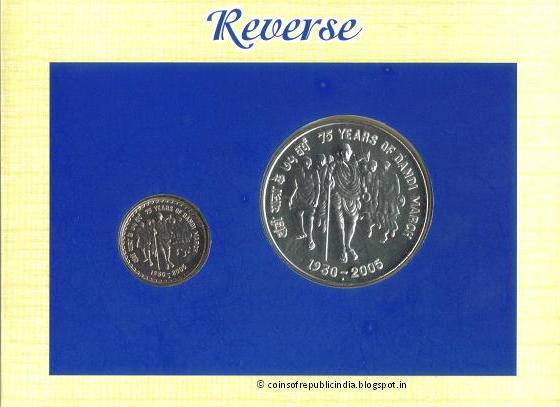
In the Year 2005 a Commemorative Proof Set and UNC Set was released to commemorate the Salt Satyagraha or Dandi March as is popularly called.
The details are;


The Salt Satyagraha, which began with the Dandi March on March 12, 1930, was an important part of the Indian independence movement. It was a campaign of nonviolent protest against the British salt monopoly in colonial India, and triggered the wider Civil Disobedience Movement. This was the most significant organized challenge to British authority since the Non-cooperation movement of 1920–22, and directly followed the Purna Swaraj declaration of independence by the Indian National Congress on January 26, 1930. Mahatma Gandhi led the Dandi march from his base, Sabarmati Ashram near Ahmedabad, to the sea coast near the village of Dandi. As he continued on this 24 day, 390 km march to produce salt without paying the tax, growing numbers of Indians joined him along the way. When Gandhi broke the salt laws at 6:30 am on April 6, 1930, it sparked large scale acts of civil disobedience against the British Raj salt laws by millions of Indians. The campaign had a significant effect on changing world and British attitudes toward Indian independence and caused large numbers of Indians to join the fight for the first time.
The Dandi March and the ensuing Dharasana Satyagraha drew worldwide attention to the Indian independence movement through extensive newspaper and newsreel coverage. The Salt March to Dandi, and the beating by British police of hundreds of nonviolent protesters in Dharasana, which received worldwide news coverage, demonstrated the effective use of civil disobedience as a technique for fighting social and political injustice
The commemorative is a fitting tribute to one of the significant landmarks in India’s freedom struggle.

Gayarh murti (11 statues)
The sculpture, by Devi Prasad Roy Choudhary, depicts the famous Dandi March led by Mahatma Gandhi in 1931 against oppressive salt taxes imposed by the British regime.
A stone memorial was built in New Delhi. It is located outside the President House.


Proof Set:
Both Coins of Rs 100 and Rs 5
See Previous Post


UNC Set:
Both Coins of Rs 100 and Rs 5


UNC Set Remint:
Both Coins of Rs 100 and Rs 5
All the details same as Original except where it says "Minted by" it says "Reminted by"