Showing posts with label YR-1961 To 1970. Show all posts

1970 - Food for All - UNC Set

This Post gives the details of UNC Set. For Proof Set, please refer to Previous Post

The Food For All was theme was used for commemorative coins. Originally issued in the year 1970. Only proof sets are available in this year. However the same set was also available in the year 1971 along with circulation coins. One can Distinguish between the 1970 Proof set and the 1971 proof sets by looking at the date on the coins. Its a unique in the sense that only for this series do we have proof sets issued in 2 years.

The following Proof sets and UNC were received.
The details are;


Note: There were 2 releases for this issue. One in 1970 and other in 1971. The design is same, the only difference is the date on the coins.

The Food and Agriculture Organization of the United Nations (FAO)is a specialized agency of the United Nations that leads international efforts to defeat hunger. Serving both developed and developing countries, FAO acts as a neutral forum where all nations meet as equals to negotiate agreements and debate policy. The FAO was established on 16 October 1945 in Quebec, Canada.

The year 1970 marks the 25th anniversary of the Organisation.

FAO is composed of eight departments: Administration and Finance, Agriculture and Consumer Protection, Economic and Social Development, Fisheries and Aquaculture, Forestry, Knowledge and Communication, Natural Resource Management and Technical Cooperation.


Proof Set: Year 1970
Coins of Rs 10 and 20 Paise plus regular coins of 1,2,3,5,10,50 Paise and 1 Rupee.
Refer to Previous Post.

UNC Set 1: 1970  Both Coins of Rs 10 and 20 Paise


UNC Set 2: Regular Coins of 1,2,3,5,10,50 Paise and 1 Rupee


1969 - Mahatma Gandhi Birth Centenary - UNC Set


This post gives the details of the UNC Set. The Previous post gives the details of Proof Set

The second Occasion for the release of commemorative coins in India was on the Mahatma Gandhi Birth Centenary in the year 1969. For the fist time an Rs 10 coin was issued. The coin was part of the Proof Set as well as released for general circulation. After Independence this is the first time India had a Silver coin in circulation. This was followed by another 2 Rs 10 coins in the next 2 years before being discontinued. The Silver coins from the year 1973 onwards were only available as part of Proof or an UNC Set and not for general circulations.
The details of the coins are as below;


Mohandas Karamchand Gandhi (2 October 1869 – 30 January 1948) was the pre-eminent political and ideological leader of India during the Indian independence movement. A pioneer of satyagraha, or resistance to tyranny through mass civil disobedience—a philosophy firmly founded upon ahimsa, or total nonviolence—Gandhi led India to independence and inspired movements for civil rights and freedom across the world.Gandhi is often referred to as Mahatma an honorific first applied to him by Rabindranath Tagore. In India, he is also called Bapu and officially honoured as the Father of the Nation. His birthday, 2 October, is commemorated in India as Gandhi Jayanti, a national holiday, and worldwide as the International Day of Non-Violence.
Gandhi first employed non-violent civil disobedience as an expatriate lawyer in South Africa, in the resident Indian community's struggle for civil rights. After his return to India in 1915, he set about organising peasants, farmers, and urban labourers in protesting excessive land-tax and discrimination. Assuming leadership of the Indian National Congress in 1921, Gandhi led nationwide campaigns for easing poverty, expanding women's rights, building religious and ethnic amity, ending untouchability, increasing economic self-reliance, but above all for achieving Swaraj—the independence of India from foreign domination. Gandhi famously led Indians in protesting the British-imposed salt tax with the 400 km Dandi Salt March in 1930, and later in calling for the British to Quit India in 1942. He was imprisoned for many years, on many occasions, in both South Africa and India.
Gandhi strove to practice non-violence and truth in all situations, and advocated that others do the same. He lived modestly in a self-sufficient residential community and wore the traditional Indian dhoti and shawl, woven with yarn he had hand spun on a charkha. He ate simple vegetarian food, and also undertook long fasts as means of both self-purification and social protest.


The Proof Set:
Coins of Rs 10, Rs 1, 50 and 20 Paise along with Regular coins of 1,2,3,5,10 paise
See Previous Post

UNC Set: 
Coins of Rs 10, Rs 1 and 20 and 50 Paise
Green Cover

 Brown Cover


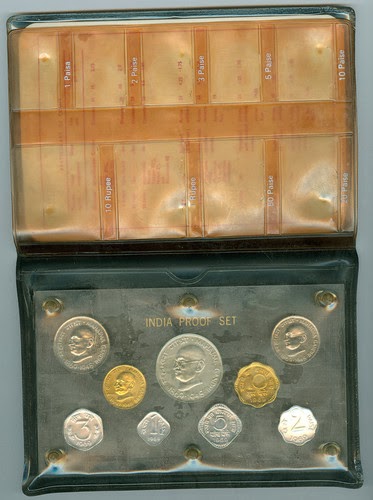
1969 - Mahatma Gandhi Birth Centenary - Proof Set


This post gives the details of the Proof Set. The Next post gives the details of UNC

The second Occasion for the release of commemorative coins in India was on the Mahatma Gandhi Birth Centenary in the year 1969. For the fist time an Rs 10 coin was issued. The coin was part of the Proof Set as well as released for general circulation. After Independence this is the first time India had a Silver coin in circulation. This was followed by another 2 Rs 10 coins in the next 2 years before being discontinued. The Silver coins from the year 1973 onwards were only available as part of Proof or an UNC Set and not for general circulations. The Mumbai Mint adopted the “B” Mint mark from this issue on Proof Coins.
The details of the coins are as below;


Mohandas Karamchand Gandhi (2 October 1869 – 30 January 1948) was the pre-eminent political and ideological leader of India during the Indian independence movement. A pioneer of satyagraha, or resistance to tyranny through mass civil disobedience—a philosophy firmly founded upon ahimsa, or total nonviolence—Gandhi led India to independence and inspired movements for civil rights and freedom across the world.Gandhi is often referred to as Mahatma an honorific first applied to him by Rabindranath Tagore. In India, he is also called Bapu and officially honoured as the Father of the Nation. His birthday, 2 October, is commemorated in India as Gandhi Jayanti, a national holiday, and worldwide as the International Day of Non-Violence.
Gandhi first employed non-violent civil disobedience as an expatriate lawyer in South Africa, in the resident Indian community's struggle for civil rights. After his return to India in 1915, he set about organising peasants, farmers, and urban labourers in protesting excessive land-tax and discrimination. Assuming leadership of the Indian National Congress in 1921, Gandhi led nationwide campaigns for easing poverty, expanding women's rights, building religious and ethnic amity, ending untouchability, increasing economic self-reliance, but above all for achieving Swaraj—the independence of India from foreign domination. Gandhi famously led Indians in protesting the British-imposed salt tax with the 400 km Dandi Salt March in 1930, and later in calling for the British to Quit India in 1942. He was imprisoned for many years, on many occasions, in both South Africa and India.
Gandhi strove to practice non-violence and truth in all situations, and advocated that others do the same. He lived modestly in a self-sufficient residential community and wore the traditional Indian dhoti and shawl, woven with yarn he had hand spun on a charkha. He ate simple vegetarian food, and also undertook long fasts as means of both self-purification and social protest.


Proof Set:
Coins of Rs 10, Rs 1, 50 and 20 Paise along with Regular coins of 1,2,3,5,10 paise
Available in Green, Brown and Blue Covers.


Paper Envelope

Brown Cover


Blue Cover


Red Cover


Recently I cam across this package on eBay US, sometimes being mis-sold as VIP. During the early period, there were quite a few Companies/Dealers in US that would place bulk orders with the Mint and get the sets. These sets look similar, where the Proof set was put into an acrylic packaging presumably to protect coins and the Mint's packaging was very poor.


UNC Set: Coins of Rs 10, Rs 1 and 20 and 50 Paise
See the Next Post


10 Rupees Commemorative Coin - Part 1 - Silver Coins

The Index to All Articles is here

This Post is Organized in 2 parts.
Part 1: Silver Coins

Part 2: Bi-Metallic Coins


The first Rs 10 commemorative coin for general circulation was in the year 1969 on the occasion of Birth Centenary of Mahatma Gandhi, after this there were 2 more issues in Silver in general circulation. The 1969 Silver achieves the distinction of being the first coin in silver post independence. These are the only 3 Silver coins in the Republic India coinage that were in general circulation. Post the Silver coins were only in Proof Sets and UNC Sets. In the year 2005 the denomination was issued as definitive coins in Bi-Metallic. Subsequently the coins were also issued in commemorative.
The Coins of 1969 and 1970 were made of 80% Silver, from 1972 the metal was changed to Quaternary alloy with 50% Silver.

1969 Mahatma Gandhi Centenary
The 10 Rupees, 1969 Mahatma Gandhi Centenary, showing the bust of Mahatma Gandhi.  The mint details and Description are;


Although the Bombay [Mumbai] Mint had earlier released a commemorative in 1964 on Jawharlal Nehru, this was the first time a coin in Silver was struck after Independence. Its also for the first time the Mint used a different mint mark than “Diamond” that it uses for circulation strikes. It used “B” to indicate proof strike. Later when the name changed to Mumbai, it changed the proof mint mark to “M”.
Amongst the few coins in Indian coinage where the mint mark is on Obverse rather than Reverse.


Mints: Mumbai, Kolkata
Reverse:
Bust of Mahatma Gandhi
Dated 1969 – 1948
Legend Mahatma Gandhi in English and Hindi

1970 Food For All
The 10 Rupees, 1970 Food For All, depicts Sun Above, Lotus below and wheat ears on either sides. This was issued on the 25th anniversary of the Food & Agriculture organization of United Nations. The mint details and Description are;


This is amongst the rare coins of Rs 10 Denomination, the Kolkata Mint coin is most rare amongst all the 6 silver coins.

Mints: Mumbai, Kolkata
Reverse:
Sun Above, Lotus flower below, Wheat ears on either side
Date 1970 Below Lotus. Mint mark below date.
Legend Food for All

Die Variety:
The Mumbai Mint coin in Proof and UNC set had a slightly different die. There were wavers in the Year as well. In the Circulation Strikes these waves are not present in the Year. The same is also applicable to the 20 paise coin struck.


1972 Independence Jubilee
The 10 Rupees, 1972 Independence Jubilee, depicts a Person holding a Flag. This was the 3rd and last of the Silver Coins issued for general circulation. Post this the Rs 10 denomination was only available in Proof and UNC Set. The mint details and Description are;


Among the few coin that has the legend only in Hindi.

Mint: Bombay, Calcutta
Reverse:
Person Holding a Flag
Date 1947 – 1972 on left side
Legend 25th Independence Anniversary in Hindi


One Rupee Commemorative - Part 1 Cupro-Nickel Series

The Index to All Articles is here

This Post is Organized in 3 parts.
Part 1: Cupro-Nickel: 1964 to 1989 Issues
Part 2: Cupro-Nickel: 1990 to 1993 Issues
Part 3: Stainless Steel: 1994 to Now

Part 1: The One Rupee commemorative began as the first commemorative coin denomination. The first issue was on the occasion of Death of the first Prime Minister Jawaharlal Nehru.


1964 Jawaharlal Nehru 
The One Rupee, 1964 Jawaharlal Nehru showing Bust of Nehru. The coins were released to mark the Death of India's longest serving Prime Minister. The mint details and Description are;


Notes:
This is the only personality so far to have coins released 2 times. One on his death and other one on his birth centenary.
The legend is in English only on the Rs 1 coin. On the 50 paise coin, there are 2 designs, one has legend in English and the other in Hindi. It was only from subsequent issues where the legend was always in both Hindi and English.
The Mint mark for this coin and Gandhi coin is on the Obverse rather than Reverse as in other commemorative issues.

Mints: Bombay / Mumbai and Calcutta / Kolkata

Reverse:
Depicts the bust of Nehru
Date 1889 – 1964
Legend: "Jawaharlal Nehru" on the top
______________________________
1969 Mahatma Gandhi Birth Centenary
The One Rupee, 1969 Mahatma Gandhi Birth Centenary, Independent Indian commemorative coin along with mint details and Description


Mints: Mumbai, Calcutta

Reverse:
Bust of Mahatma Gandhi facing left
Date 1869 – 1949
Legend: Mahatma Gandhi in English and Hindi

Die Variety: None
______________________________

1985 International Youth year
The One Rupee, 1985 International Youth year, with Three outline facial profile between dow and laurel branch. The mint details and Description are;

Notes:
The mint was shifted to Reverse from this issue.

Mints: Mumbai, Calcutta

Reverse:
Three outline facial profile between dow and laurel branch
Date 1985 Above. Mint mark below date
Legend International Youth Year in English and “Antar-rastriya Yuva Varsh” in Hindi

Die Variety: None
______________________________

1987 Small Farmers
The One Rupee, 1987 Small Farmers, shows farmers transplanting crops. The mint details and Description are

Mints: Mumbai, Calcutta, Hyderabad

Reverse:
Farmers transplanting crop, FAO logo on top at 12 O’Clock
Date Below. Mint Mark below date
Legend Small Farmers in English. “Chote Kisan” in Hindi

Die Variety: None
______________________________

1988 Rain Fed Farming
The One Rupee, 1988 Rain Fed Farming, shows women holding a flower and rain coluds in background. The mint details and Description are;


The World Food on 16th October every year highlights areas where action is needed. The Rain-fed Farming highlights the need to achieving food security by using Rain-fed farming. This also promotes Rural youth with employment as farming is an important employment in rural India.
Mints: Mumbai, Kolkata
Reverse:
A farmer’s wife with Sun flower stalks in her hands in a rural background; a raining cloud and a pair of bullocks drawing a plough.
Dateabove at 12 O’Clock position, Mint Mark below date.
The legend RAINFED FARMING, FAO in English and “Varsha Sinchit Kheti” in Hindi. The date 1988 on top. The mint mark below the Date.

Die Variety: None
______________________________

1989 Food and Environment
The one Rupee, 1989 Food and Environment, released on world food day, shows sun above with wheat stalks in side. The mint details and Description are;


Mint: Mumbai, Hyderabad, Noida

Reverse:
Sun above, wheat stalks in side
Date 1989 Below wheat corns. Mint mark between Hindi & English Legend
Legend Food and Environment, World Food Day in English. “Khadya Evam Paryavaran and Vishwa Khadya Divas” in Hindi

Die Variety: None
______________________________

1989 Jawaharlal Nehru
The One Rupee, 1989 Jawaharlal Nehru, released on his birth centenary, the second release of a commemorative for the same leader. The first being on his death in 1964. The mint details and Description are;


Note: The first commemorative in Rs 1 denomination minted by all 4 mints. So far the only personality to have three commemorative issues one on Death in 1964, one on the Birth Centenary in 1989 and one in 2015 on 125th Birth Anniversary in Rs 5 denomination.

Mints: Mumbai, Kolkata, Hyderabad, Noida
Reverse:
Bust of Jawaharlal Nehru facing right with the landmark Cap.
Date Below. Mint mark below date
Legend Jawaharlal Nehru Centenary in English and “Jawaharlal Nehru Janm Shati” in Hindi

Die Variety: Mumbai Mint has 2 die designs for Reverse. The easy identification is Long and Short Rims as shown in the picture.

______________________________


50 Paise Commemorative Coins

There were 10 Commemorative coins issued in the 50 Paise denomination, beginning in 1964 on occasion of Death of Nehru. The most unique fact of this coin is that same coin was minted with legend in English and other coin with Legend in Hindi. There is no such other coin in Indian Coinage.

1964 Jawaharlal Nehru English

The 50 Paise, 1964 Independent Indian commemorative coin with legend "Jawaharlal Nehru" shows a bust of Nehru. The mint details and Description are;


 Mints: Mumbai, Kolkata

1964 Jawaharlal Nehru Hindi

The 50 Paise, 1964 Independent Indian commemorative coin with Legend "Jawaharlal Nehru" shwos a Bust of Nehru. The mint details and Description are;


  Mints: Mumbai, Kolkata

1969 Mahatma Gandhi Birth Centenary

The 50 Paise, 1969 Mahatma Gandhi Birth Centenary, with Legend "Manatma Gandhi". The mint details and Description are;


  Mints: Mumbai, Kolkata

1972 Independence Jubilee

The 50 Paise, 1972 Independence Jubilee, with Legend "25th Independence Jubilee" shows a person holding a Flag. The mint details and Description are;


Mints: Mumbai, Kolkata

1973 Grow More Food

The 50 Paise, 1973 Grow more Food, shows Grain Stalks on both side. The mint details and Description are;


  Mints: Mumbai, Kolkata

1982 National Integration

The 50 Paise, 1982 National Integration, shows Map of India with Flag. The mint details and Description are;

  Mints: Mumbai, Kolkata

1985 Reserve Bank Of India Golden Jubilee

The 50 Paise, 1985 Reserve Bank Of India Golden Jubilee, shows the Logo of RBI, that is Tiger and Palm Tree with Crest of RBI. The mint details and Description are;


  Mints: Mumbai, Kolkata, Hyderabad

1985 Death of Indira Gandhi

The 50 Paise, 1985 Death of Indira Gandhi, shows bust of Indira Gandhi. The mint details and Description are;

   Mints: Mumbai, Kolkata, Hyderabad

1986 Fisheries

The 50 Paise, 1986 Fisheries, shows people with fishing nets. The mint details and Description are;


   Mints: Mumbai, Kolkata, Hyderabad

1997 50 Years of Independence

The 50 Paise, 1997 50 Years of Independence, Depicts Mahatma Gandhi Marching with followers. The mint details and Description are;

  Mints: Mumbai, Kolkata, Hyderabad, Noida


50 Paise Commemorative – Various Dies used in Obverse

The 50 Paise commemorative have had 5 dies designed. Of these 3 were designed only for use with specific coin.